
If one bad encounter put you off, the order may simply have been wrong. How to climb from mild to strong, what makes it easy, and where this cheese came from.
Where the flavour comes from
Blue mould is mixed into the curd, and once the cheese has set it is pierced repeatedly with long needles to open channels for air, because mould needs oxygen to grow. The mould spreads along those channels, which is why the blue veining on a cut face tends to run in straight lines. The taste itself comes from compounds the mould produces as it breaks down fat — that sharp, tingling sensation is exactly that. None of it is accidental, and a good deal of salt goes in alongside.
It began in a cave
In southern France there is a village called Roquefort-sur-Soulzon. Beneath it lie limestone caves formed by the collapse of a mountain called Combalou, and the rock is cut by natural fissures known as fleurines. Outside air moves through them, holding the caves at almost constant temperature and humidity year-round — precisely what blue mould wants. The story goes that a shepherd left ewe's-milk curd and rye bread in one of the caves, returned days later, and found it veined with blue. Whether it happened is unknowable, but it is exactly the sort of thing that does happen in there.
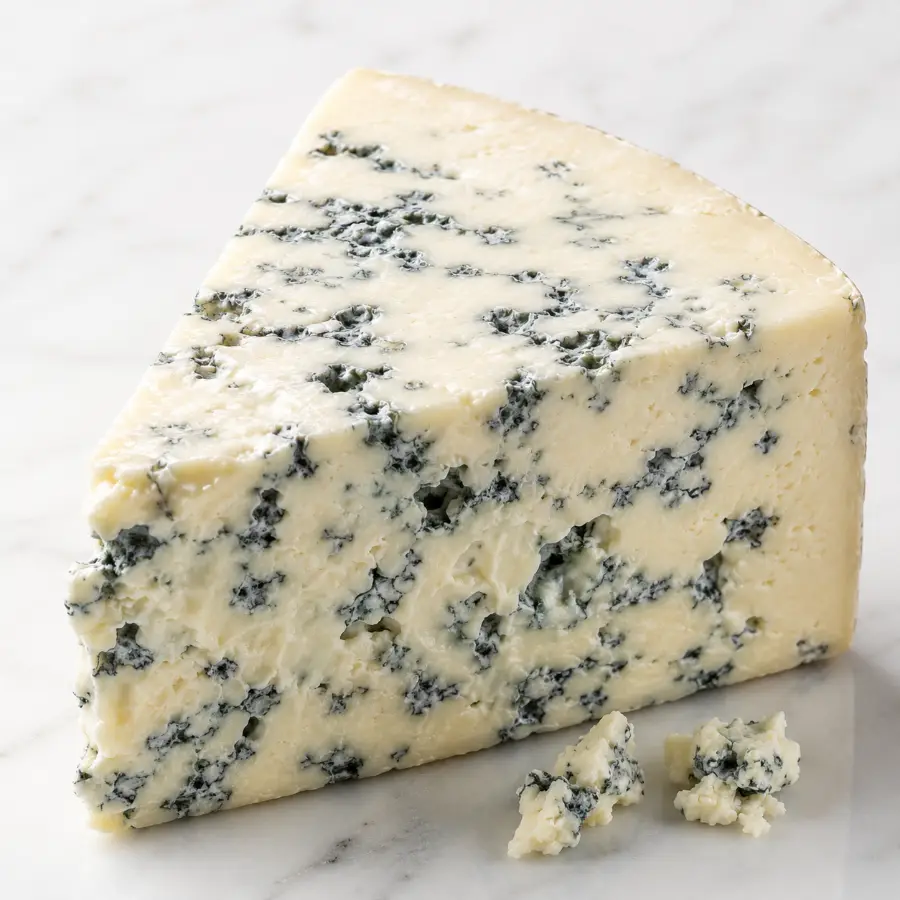
The cheese that came out of that cave:
The first cheese whose name was protected by law
In 1411, Charles VI of France granted the people of Roquefort a monopoly on ripening the cheese, because imitations were circulating and the real thing needed defending. It is among the earliest instances anywhere of a place name being protected by law — a distant ancestor of the origin-protection schemes that now cover food across Europe. People six hundred years ago already understood that a name was worth guarding. The name still belongs only to cheese ripened in those caves.
This was the first:
Start with a mild one
Blues vary more in strength than almost any other family. Begin with the creamy Italian style — the version labelled dolce is soft enough to eat with a spoon and comparatively low in salt. Once that feels comfortable, move to the crumbly English style, and only then to the rich sheep's-milk French one. Take that route in reverse and there is a good chance you conclude that blue cheese is not for you. A great many people who say exactly that simply met the strongest one first.
Ordered from mild to strong:
Temperature matters more than you would think
Cold blue cheese leads with salt and sting. Straight from the fridge it can taste like little more than a lump of salt. Thirty minutes to an hour at room temperature softens the texture and lets the layers of aroma open, which makes an enormous difference on a first attempt. And take small pieces — very thin, alongside something else. Blue cheese works by intensity in the moment rather than by volume.
Something sweet changes everything
Salt and sugar suppress each other. A spoonful of honey, a ripe pear or fig, a few raisins — any of them blunts the sharpness considerably. This is not a workaround; it is the classic European way of serving it. Add walnuts and you have contrast in texture too, and the plate is complete. Rye or nut bread carries it well, and a little on sweet, soft brioche turns straight into dessert.
It gets much easier with a drink
Blue cheese is at its most approachable in company. France settled on roquefort with sweet Sauternes, England on stilton with port, and the two arrived at the same answer — something sweet — without consulting one another. The sweetness suppresses the salt, and the salt keeps the sweetness from cloying. For beer, a roasty stout does the same job. If you are trying blue cheese for the first time, do it with a drink in hand. It is considerably less demanding that way.
These get much easier with the right glass:
If you cannot eat it plain, cook with it
Heat softens the aroma and leaves the savouriness behind. Melt a little into cream for a pasta sauce, put a sliver on grilled meat, or crumble it over a salad. Use far less than instinct suggests — 20 grams is plenty for pasta for two, and any more erases everything else on the plate. It is superb with potatoes: a little melted over a baked potato is a meal by itself. Getting used to it in cooking first, then trying it plain, is a perfectly good route in.
The one that melts happily into a dish:
The mould is meant to be there
The blue veining inside was put there deliberately. But fuzz in a colour the cheese never had, appearing on a cut face, is a different mould. A slimy surface, a stinging ammonia smell, or browning are all reasons to stop. Store it wrapped in paper inside its own sealed box — the aroma is strong enough that everything else in the fridge will otherwise acquire it. And always wipe the knife afterwards, or in a few days your brie will taste distinctly of blue.
What if I am allergic to penicillin?
A frequent question. The mould used in blue cheese belongs to the Penicillium genus but is a different species from the one that produces the antibiotic. The moulds used for blue and white-rind cheeses do not carry the genes for making penicillin at all, so they cannot produce it. So it is generally not considered a problem. An allergy to moulds themselves is a separate matter, and individual circumstances vary. If you have a diagnosed allergy, ask your clinician rather than deciding from an article — this one is general information, not medical advice.
Buying your first blue cheese
Get about 100 grams of Italian gorgonzola dolce. No more than that. Alongside it: a little honey, one pear, and some walnuts. That is the whole shopping list. Take it out half an hour before eating, slice it very thin, lay it on a slice of pear and add a drop of honey. If that combination still does not work for you, it is a matter of taste and there is no need to persist. But a good number of people change their minds right there — especially the ones who tried once, years ago, and gave up. Usually the cheese was not the problem.
What to make your first wedge:
Sources
- Laich F, Fierro F, Martín JF — Production of Penicillin by Fungi Growing on Food Products (Applied and Environmental Microbiology, 2002; 68(3):1211–1219)
- Chávez R, Vaca I, García-Estrada C — Secondary Metabolites Produced by the Blue-Cheese Ripening Mold Penicillium roqueforti (Journal of Fungi, 2023; 9(4):459)