
The specks that crunch between your teeth and the white smear across the surface are two different things — and neither means the cheese has gone off. Here is how to tell them apart.
First: it is not mould
When something white turns up on cheese, mould is usually the first thought. It is a common enough mix-up that the Wisconsin Center for Dairy Research names it as the main problem with crystals — consumers read them as mould or yeast, and so as a defect. They are not. The crunchy sort is treated as a desirable trait in a well-aged cheese. The surface sort the industry does count as a defect — not out of any health concern, but because shoppers read it as mould and leave the cheese on the shelf. The research is explicit that it poses no health risk. Telling them apart is straightforward, too. Crystals are white, hard and flat against the cheese. Mould stands up from the surface in a fuzz, and usually carries colour with it — green, blue, black.
There is more than one kind of crystal
Two of them, and they look quite different. The first is tyrosine. It is hard enough to crunch audibly, each speck distinct and brilliantly white, and it sits almost always inside the cheese — you meet it on a cut face, studded through the paste. The second is calcium lactate. That one is softer and wetter, less a speck than a smear, and it forms on the surface as well as within. So if an uncut piece has gone white and patchy on the outside, it is almost certainly calcium lactate.
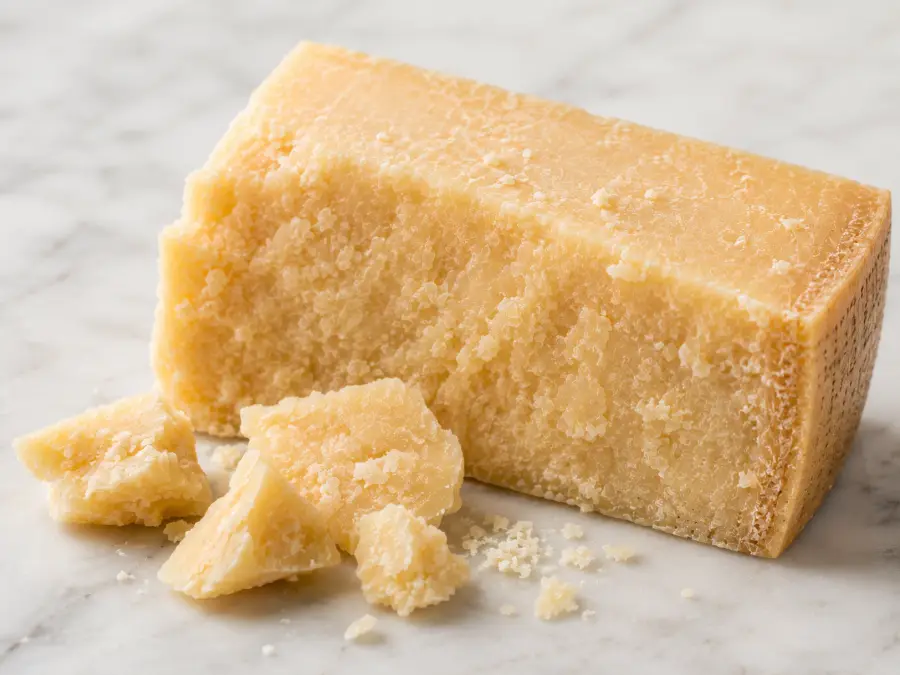
The crunchy specks are made of time
Ageing is protein being broken into smaller and smaller pieces. Amino acids are what is left at the end, and tyrosine is unusually poor at dissolving. Once there is more of it than the moisture can hold, it comes out of solution as crystals. That is why the crunch is really a measure of age. You will rarely find it in cheddar under three months, and young Italian cheeses like parmesan and romano may need eight months or more before it appears. Ripening temperature matters as well: parmesan cut in half and aged for a year, one piece at 7°C and the other at 10°C, gave larger crystals on the warmer side — more protein broken down, more tyrosine released.
Where the crunch turns up most:
The white smear has more to do with packaging
Calcium lactate arrives by another route. Lactic acid made during ageing meets the calcium in the milk, and past a certain concentration the calcium lactate crystallises out. What matters in practice is where. When cheese goes through a change in temperature it weeps moisture to its surface, and crystals grow wherever that moisture pools — under a lifted wrapper, in a fold of the plastic, on any part of the surface that is not smooth. This is also why vacuum packing suppresses them: there is nowhere for the moisture to gather. Researchers at the University of Vermont measured it directly. They sliced smoked cheddar, roughened one cut face with a cheese grater and left the opposite face smooth, then vacuum packed the slices at four degrees of tightness. Loose packaging gave heavy crystallisation on both faces. A smooth face under very tight packaging gave almost none at all — the sites where a crystal could start had simply been removed.
Taking it in and out of the fridge matters too
The same laboratory tested temperature. Smoked cheddar was held at 1°C, 5°C and 10°C, and on a weekly cycle between 1°C and 10°C. The surface ended up most heavily covered at 10°C, because the moisture weeping out tracked the temperature: 10 mg at 1°C against 60 mg at 10°C, a sixfold difference. The cycled cheese is the interesting one — at 45 mg it behaved much like cheese held constantly at the warmer temperature. And individual crystals, once formed, grew at the same rate whatever the temperature. What temperature changes is not how fast a crystal grows but how many places one starts.
A damp package is worth a second look, though
The crystals themselves are harmless, but moisture pooling at the surface carries a second meaning. That same free moisture is a good place for yeast and mould to grow. It is not that crystals are risky — it is that the conditions which produce crystals overlap with the conditions which produce mould. So if the wrapper has lifted and the surface underneath is wet, it is worth looking closely at what you are seeing. Anything coloured, or anything standing up in a fuzz, is not a crystal.
Crystals do not actually taste of anything
You will see them sold as flavour crystals, but neither tyrosine nor calcium lactate contributes much taste on its own. The phrase works anyway, because a cheese aged long enough to grow crystals has had time to build flavour by every other route. The crystals are a signal rather than a cause. The crunch is real enough — but that is texture, not taste.
Which cheeses to expect them in
Tyrosine is common in hard Italian cheeses such as parmesan and romano, and in the Swiss styles. It also shows up in long-aged gouda and cheddar, and there it tends to follow a particular culture, Lactobacillus helveticus, added for flavour. That bacterium breaks peptides apart so vigorously that it frees more tyrosine than it or anything else in the cheese can use. Calcium lactate is seen most often on aged cheddar, and also on colby, aged parmesan and gouda. So a single cheese is not limited to one kind.
There is a third crystal, as it happens
Researchers at the University of Vermont ran x-ray diffraction across the crystals of several cheeses. The crunch in parmigiano and long-aged gouda was tyrosine, as expected. But the same cheeses also gave up white pearls as much as 6 mm across which appeared to be not tyrosine but leucine — and the authors were careful to call that identification tentative rather than settled. Long-aged gouda can pack crystals into its eyes as well, and both kinds turned up there. Nor is this only a hard-cheese affair: crystals were found in the smeared rinds of soft washed-rind cheeses, where they may lie behind the faintly gritty texture you sometimes meet.
The washed-rind sort:
Sources
- Wisconsin Center for Dairy Research — Crystallization in Cheese (Dairy Pipeline 26:3, 2014)
- Rajbhandari & Kindstedt — Surface roughness and packaging tightness affect calcium lactate crystallization on Cheddar cheese (Journal of Dairy Science 97:1885–1892, 2014)
- Rajbhandari, Patel, Valentine & Kindstedt — Effect of storage temperature on crystal formation rate and growth rate of calcium lactate crystals on smoked Cheddar cheeses (Journal of Dairy Science 96:3442–3448, 2013)
- Tansman, Kindstedt & Hughes — Crystal fingerprinting: elucidating the crystals of Cheddar, Parmigiano-Reggiano, Gouda, and soft washed-rind cheeses using powder x-ray diffractometry (Dairy Science & Technology 95:651–664, 2015)
- Cheese Science Toolkit — Cheese Crystals