
No special equipment needed. How to keep the cheese from splitting, what to serve alongside, and how these two dishes came to stand for Switzerland.
Fondue became a national dish through a marketing campaign
It sounds like something Alpine herdsmen ate for centuries, but fondue only became Switzerland's national dish in the 1930s, when the Swiss cheese cartel ran a campaign to sell more cheese. Recipes were posted to households, scaled from four servings all the way up to a hundred — the explicit aim being to normalise cooking with large quantities of cheese at once. Later came a slogan, roughly fondue is good and makes a good mood. Before all this, fondue was a regional speciality of the French-speaking cantons and nothing more. But the campaign outgrew its commercial purpose: in a country split by language and region, the image of everyone dipping into one pot became a symbol of unity. In Switzerland it remains the food of winter and of company.
Which cheeses to use
The classic is two Alpine cheeses in combination: one deep and savoury, one mild and stretchy, in equal parts. Fribourg has a version whose name simply means half and half — precisely 50 per cent gruyère and 50 per cent of the local cheese. Reckon on 200 grams per person for a generous meal, and grate it, which melts far more evenly. On the French side comté is used instead, giving a softer, sweeter result. If none of those is available, gruyère blended with emmental or gouda does the job perfectly well.
What goes into the pot:
Two things that stop it splitting
First, white wine — about 100 millilitres per 200 grams of cheese. Its acidity loosens the cheese proteins so everything stays smooth. Choose something dry and properly tart; at a pinch, water with a squeeze of lemon does something similar. Second, toss the grated cheese with a tablespoon of cornflour, which holds the fat droplets in suspension and stops the oil rising. Rub the inside of the pot with a cut clove of garlic for a background note. The Swiss finish with a spoonful of kirsch, which contributes aroma and also thins the mixture very slightly.
Low heat, and stir in figure eights
Boil it and it splits. Melt over a low flame, adding the cheese a handful at a time and waiting for each to disappear before the next goes in. Stir in figure eights or zigzags rather than circles: a circular stir simply spins the mass around while the fat separates out of it. If it does split, raise the heat a little and whisk hard — that usually brings it back, and a little more starch slurry will finish the job. Keep a very low flame under the pot once it reaches the table, or it sets.
The crust at the bottom is the best part
When the pot is empty there is a thin sheet of toasted cheese stuck to the base. French speakers call it la religieuse, the nun, and at a Swiss table it is the most sought-after part of the meal — golden, nutty and crisp. Let it colour without burning, then lift it off whole with a wooden spatula and share it out. Putting the pot straight into water without eating it would strike any Swiss guest as a small tragedy. Tradition also imposes a forfeit on anyone who drops their bread into the pot, which tells you something about the spirit of the occasion.
Raclette means scraping
This one comes from the Valais, and the name is simply the French verb for to scrape. The story goes that herdsmen in the mountains stood half a wheel of cheese beside the fire and scraped the melted face onto potatoes. Cheap, filling and untroubled by summer heat — that was cheese and potatoes. The scraping was distinctive enough that the action became the name of the dish, and by the late nineteenth century the name of the cheese itself. A dish naming its own ingredient is not a common sequence.
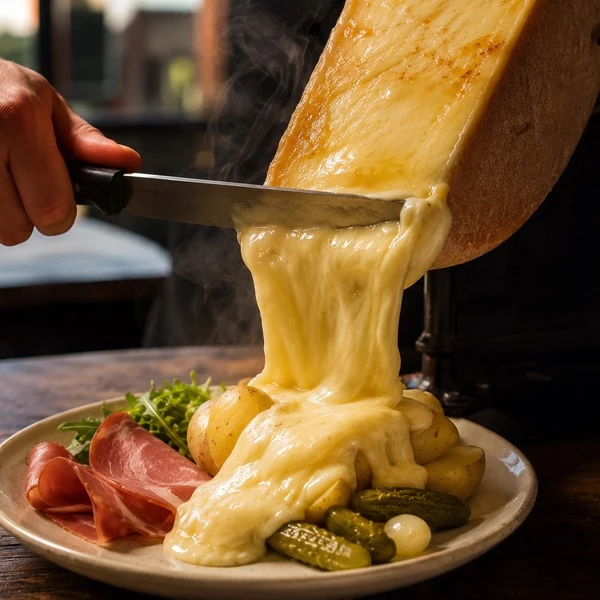
The name belongs to this cheese:
You do not need a raclette grill
A dedicated grill is convenient but entirely optional. Slice the cheese thickly into an ovenproof dish and melt it under a grill, in the oven or in an air fryer — a frying pan works too. Boil the potatoes in advance and lay out the accompaniments while the cheese melts, because melted cheese has to be eaten immediately and the order does not survive being reversed. Gouda or gruyère substitute well if raclette cheese is unavailable, though avoid anything long-aged, which tends to weep oil.
These melt fine without the grill:
The accompaniments are really about acidity
Boiled potatoes, cornichons, pickled onions and thinly sliced cured ham are the standard, and the one you cannot skip is the sour element. Melted cheese becomes tiring within four mouthfuls, and one pickle resets it every time. Any sharp pickled vegetable will do. For fondue, dipping bread should have a firm crust — soft crumb falls off the fork. Day-old baguette is actually better, cut into cubes each with a face of crust still attached, which holds them together.
What to drink
Locally, fondue is drunk with white wine or hot tea. The same dry white you cooked with is the easy answer, and its acidity genuinely helps cut the richness. There is a long-standing warning against cold water and fizzy drinks on the grounds that they upset the stomach — never medically established, but still widely observed in Switzerland. What is certain is that something warm is more comfortable. If you are not drinking, apple juice or black tea both work well.
Quantities and timing
For fondue, count 200 grams of cheese and 150 grams of bread per person — about 7 oz and 5 oz — four people means 800 grams, or close to 1¾ lb, of cheese, which is more than most people expect. Allow about fifteen minutes to grate and fifteen to melt; grating ahead makes the evening much calmer. For raclette, 200 to 250 grams of cheese per person and four or five potatoes each. Both dishes are finished at the table rather than before it, so the essential preparation is having every accompaniment laid out first. Once the cheese starts melting you cannot leave the room.
What to do with leftovers
Leftover fondue sets solid as it cools. Do not throw it away — the next day, warm it gently with a splash of milk and it comes back. Use it as a pasta sauce, or spread it on bread and grill it, or pour it over boiled potatoes. Leftover raclette cheese can simply be eaten sliced, or tucked into a sandwich and toasted, where it melts obligingly. Soaking the pot in hot water lifts the stuck-on cheese easily — but check first that somebody has eaten the crust.