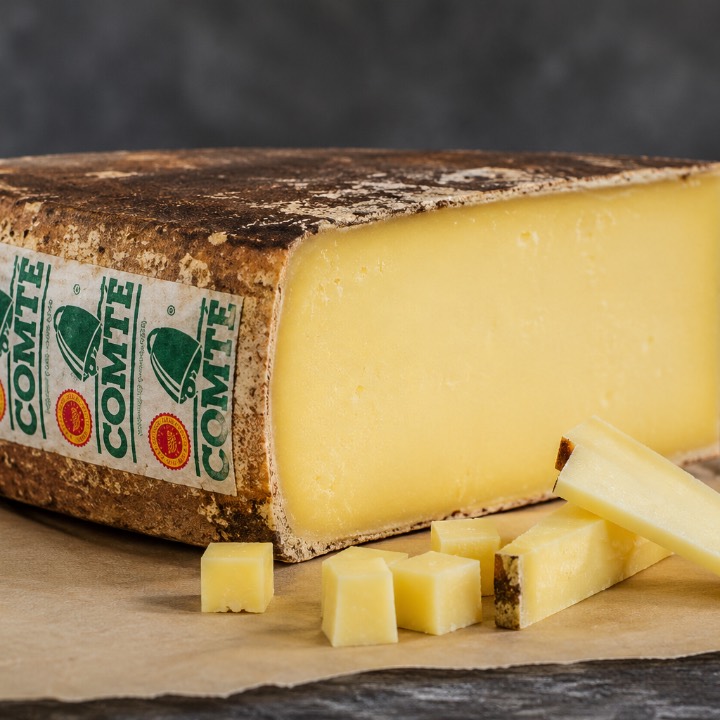
Three yellow blocks side by side look interchangeable. Looking at the holes settles half the question on its own.
They are cousins
All three are hard cheeses born in the Alps. In the mountains, summer milk had to last until winter, and the answer was to make it big and age it long. So all three are made as large wheels from curd that is cooked and pressed — which is also why they slacken smoothly under heat instead of pulling into strings, and why they are all good melters. Gruyère and emmental are Swiss; comté comes from the French Jura.
Made big in the mountains and aged long:
The holes settle half of it
The Swiss cheese riddled with big holes is emmental, not gruyère — the mix-up is extremely common. Emmental's holes run from cherry to walnut in size, left by gas as propionic bacteria ferment the lactic acid. Emmentaler AOP is the only Swiss AOP cheese permitted to use those bacteria. Gruyère is dense: where openings appear at all they are 4 to 6 mm, and the standard does not require them. Comté has almost none either.
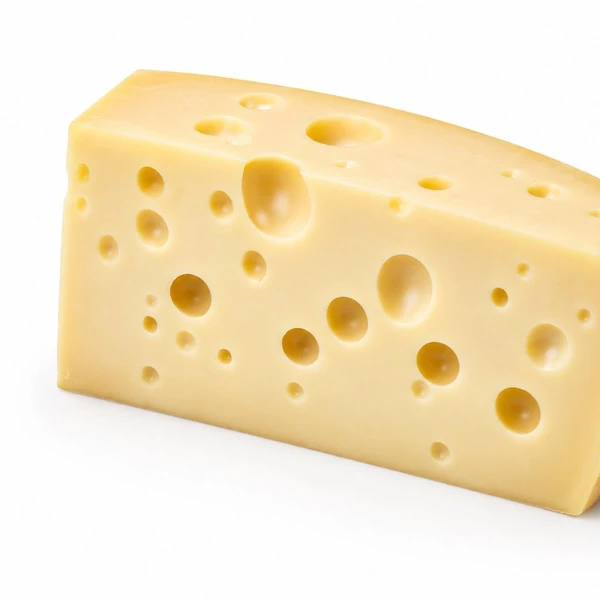
Flavour deepens in this order
Emmental is the mildest — roasted hazelnut with a quiet sweetness and a note of dry hay, distinct in aroma but never sharp. Gruyère is saltier and much more savoury; past a year it turns toward boiled ham and roasted chestnut, and crystals start to crunch. Comté opens on nuts and follows with something like caramel, and it is the softest-natured of the three. Price generally climbs in the same order.
They are for different jobs
For anything melted — fondue, a gratin, onion soup — reach for gruyère, whose savour survives the heat rather than disappearing into it. For sandwiches, or for feeding children, emmental is the easy one: mild, a good melter, and it pulls long strings. To eat in pieces or lay on a board, comté. It is a cheese that shifts with the season and the herd, and wheels made from summer-pasture milk are yellower and noticeably brighter in aroma.
What to check when buying
The name alone is not enough. Le Gruyère AOP and Emmentaler AOP are not the same thing as plain gruyère or emmental, which may have been made well outside Switzerland. Comté's coloured bands are widely misread: green and brown reflect a score out of twenty from the grading panel, and say nothing about age or the direction of the flavour. If you want an older wheel, look for the months printed on it rather than the band. And modern emmental having smaller, fewer holes is not a fault — better milking equipment leaves less of the hay dust those holes used to grow around.