
They sit side by side and the prices are not close. Here is what makes the difference, and when that difference is worth paying for.
The rulebooks differ
They look alike and get used the same way, but they are held to different standards. Four things separate them.
- Ageing — Parmigiano Reggiano must pass twelve months before it earns its stamp; grana padano needs nine
- Feed — the rules are stricter for parmigiano: hay and grass only, no silage
- Area — the territory where parmigiano may be made is far smaller
- Additives — parmigiano is made without any, while grana padano uses lysozyme to control its fermentation
Two hard cheeses held to different standards:
Which is why they taste as they do
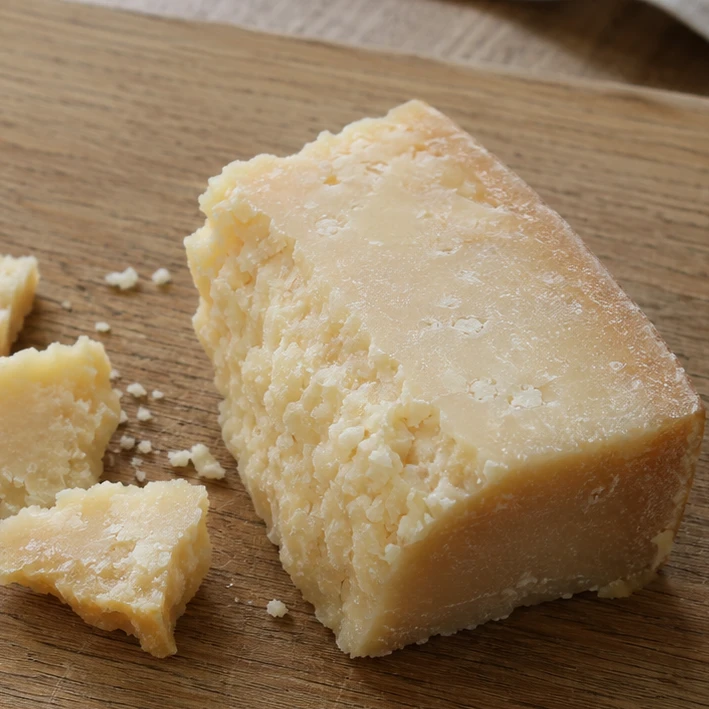
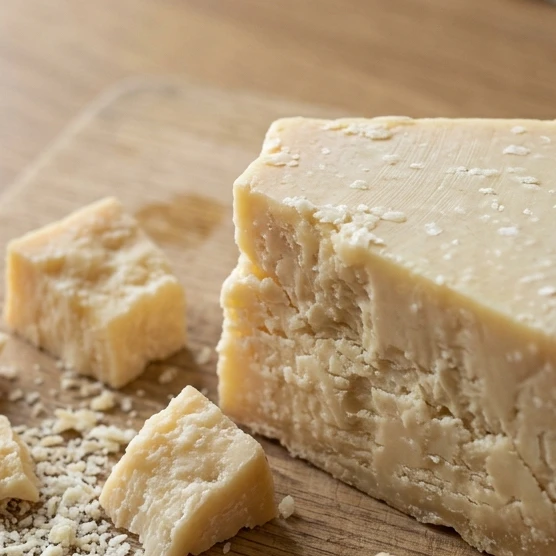
Parmigiano is deeper, saltier and more savoury, and it carries more of those white specks that crunch between the teeth. Those are not salt but amino acid crystals formed as protein breaks down in ageing, so an older wheel has more of them. Grana padano is milder and moister with less of that crunch — which makes it the better choice when the cheese is not supposed to shout.
The name already means grain
Both belong to the grana family. In Italian, grana is the word for how coarse or fine the grains are when a mass breaks apart, and it goes back to Latin granum, a seed. The cheese sense is a contraction of formaggio di grana, and the dictionary defines it as a hard cheese with a finely granular paste. Which is why these cheeses do not slice thinly — they fracture along the grain, and why the tool for opening a wheel is a wedge rather than a blade.
They used to be one cheese
There is a reason the two resemble each other so closely. Through the Middle Ages a grana carried the name of wherever it came from — lodesano, milanese, piacentino, mantovano. Further back, the monks who aged it are said to have called it caseus vetus, old cheese. The split came at the Stresa convention of 1951, where grana lodigiano was divided into two types: the two we now call Grana Padano and Parmigiano Reggiano. A consortium for Grana Padano followed in 1954 and the name was recognised by decree in 1955. Parmigiano Reggiano got there earlier — a stamp bearing the name was in use by 1934, and the term was made official in 1938.
Is the price gap audible?
Eaten in pieces, yes, clearly. Grated into cooking, much of it disappears. If it is going over pasta or melting into soup, grana padano does the job, and it costs less per kilo, which makes it the sensible everyday block. Where the cheese itself is the point — broken into shards, or laid on a board — parmigiano earns the difference. Keeping both and using them for different jobs is a perfectly reasonable answer.
Parmesan is a separate question
Inside Europe, anything labelled parmesan has to be Parmigiano Reggiano — the European Court of Justice settled that in 2008. Outside Europe the word is generic and anyone may use it, so the shaker of powdered parmesan may be an entirely different product, and the ingredients often include cellulose or other cheeses blended in. If you want the real thing, look for the long name.
What to check when buying
Parmigiano has PARMIGIANO-REGGIANO stencilled in dots all over its rind, so a wedge with the rind attached settles it instantly. For grana padano, look for the Grana Padano DOP mark on the rind or the pack. For both, pre-grated tubs lose their aroma quickly, so buy a block and grate as you go. And if you intend to eat grana padano in pieces rather than grate it, choose a riserva aged past twenty months — the nuttiness and sweetness are far more pronounced.
Sources
- Consorzio per la Tutela del Formaggio Grana Padano — La storia e l’heritage
- Consorzio del Formaggio Parmigiano Reggiano — La storia del Consorzio
- Istituto della Enciclopedia Italiana Treccani — Vocabolario on line, s.v. ‘grana¹’
- Istituto della Enciclopedia Italiana Treccani — Vocabolario on line, s.v. ‘grana³’