
Put curds, curd cheese and cottage cheese side by side and it is genuinely hard to say which is which. One word is doing three jobs: an ingredient, and two quite different cheeses.
A curd is not a kind of cheese
Add rennet or acid to milk and the protein draws together, splitting it into solid lumps and a clear liquid. The lumps are the curds; the liquid is whey. Curd is not the name of any particular cheese but the stage nearly every cheese passes through. Drain the whey further, press it into shape and age it for months and you have cheddar, or comté. So there is no exact answer to what kind of cheese a curd is — the word points at an ingredient.
But two things are sold under that name
This is where the confusion starts. Two products have almost the same name, differing only in word order, and they are not the same cheese. In the United States, cheese curds means the squeaky yellow lumps. In Britain, curd cheese means a soft white fresh cheese. Separate those two and the rest falls into place.
American cheese curds — the squeaky ones
These are lifted out partway through making cheddar, before pressing and ageing: unfinished cheddar, in effect. They squeak because the protein is still a tight network that rubs against tooth enamel. That network comes apart two ways — the acidity of the starter cultures weakens it, and enzymes left from the milk and the rennet cut the protein down. So the squeak lasts anywhere from a few days to a couple of weeks depending on how the curds are kept and served. Refrigeration quietens them, though a few seconds of warming brings much of it back. Wisconsin eats them by the handful, and Canada piles them onto chips with gravy as poutine.
Press these and age them for months and you get:
Some cheeses are built to keep squeaking
If fermentation and enzymes are what silence a curd, then avoiding both ought to help — and one cheese is made exactly that way. Finland's juustoleipä, or leipäjuusto, skips fermentation altogether and is baked at high temperature, so it holds its squeak far longer than an ordinary curd. The name translates as bread cheese, after the toasted patches the baking leaves across its surface. It is the cheese Wisconsin's dairy researchers look to when they try to build a curd that squeaks for longer.
British curd cheese — closer to quark
This one is a fresh, unaged cheese made by setting skimmed milk with acid. It has a light sourness and less fat than cottage cheese. In Britain it goes into baking — cheesecake fillings, pastries — and it served for a long time as the leaner stand-in for cream cheese. It is close kin to the quark of Germany and eastern Europe, though quark is worked smoother.
So how does cottage cheese differ?
All three begin as curds; what happens next is what separates them. Cottage cheese has its curds rinsed to wash out sourness and salt, then dressed with cream, so a bland curd and a rich cream arrive in the same spoonful and liquid moves separately in the tub. Cheese curds are neither rinsed nor creamed, so they simply taste salty, and the lumps are far bigger. Curd cheese is worked together rather than left in lumps, and made drier because it is meant for baking. Of the three, only cottage cheese is finished with cream — the liquid you see on opening the tub is the giveaway.
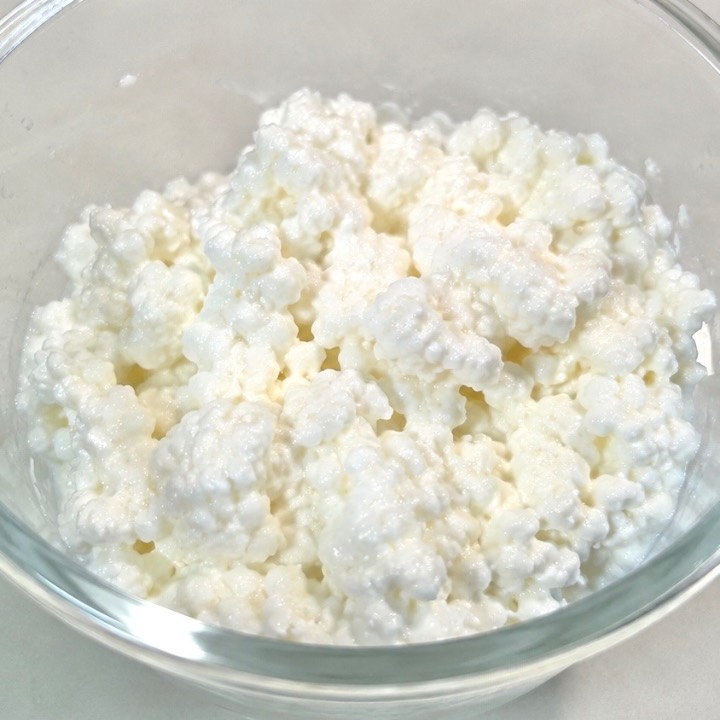
The one with a card in this guide:
The cream cheese mix-up has the same cause
People ask just as often whether cottage cheese and cream cheese are the same thing, and again the answer is the curds. Cream cheese is milk and cream fermented with lactic cultures and then worked smooth until no curd remains, which is why it spreads evenly and carries far more fat. Cottage cheese keeps its curds and stays lean. Use it where cream cheese belongs — on a bagel — and the liquid and the lumps make it a different food.
One to spread, one to spoon:
All three keep more lactose than most cheese
Ageing is what clears lactose out of cheese: the longer a wheel sits, the more the microbes eat what remains and the more moisture leaves with it. Curds, cottage cheese and curd cheese never get that time. So someone who is fine with long-aged cheddar or parmigiano may still find these three uncomfortable. If milk is difficult for you, start with a small amount and eat it alongside other food rather than on an empty stomach.
Which one is the protein choice?
This is why cottage cheese keeps coming back into fashion. It is made from skimmed milk, so the fat is low while the protein stays put, and per spoonful it carries markedly more protein for its fat than most cheese. Quark sits in the same place and takes almost no salt, so its sodium is low too. Cheese curds are a different proposition: lifted out of cheddar, they keep cheddar's fat and salt. They are a snack you eat for the squeak, not a way to get protein.
The one with protein to spare:
Curds happen in your own kitchen too
The process described at the top happens just as readily on a hob. Warm milk, add lemon juice or vinegar, and within minutes it separates into solids and clear whey; tip it into muslin and what stays behind is curd. Being acid-set, the result lands close to ricotta, and the whole thing takes half an hour. Anything needing ripening is another matter entirely — months of steady temperature and humidity — but setting and draining is well within reach. Do it once and the rest of this article reads much more easily.
Made the same way:
What to buy instead
Cheese curds are at their best within a day or two of being made, so they travel badly and are rarely exported. Curd cheese is not easy to find under that name either. British recipes calling for it will generally accept ricotta or drained cottage cheese, and quark turns up in shops that carry European groceries. If it is the squeak you are curious about, the nearest thing is halloumi — made in a completely different way, but it sings against the teeth in much the same manner.
Stand-ins, and one that squeaks: