
Fresh, bloomy, washed, hard, blue. The names pile up, but they come down to a handful of methods — here is each family, its character, and how the categories are actually drawn.
The dividing line is water
There is a real international standard for this. The Codex Alimentarius sorts cheese by how much of it is water once you set the fat aside. Above 67 per cent is soft, 54 to 69 is firm or semi-hard, 49 to 56 is hard, and below 51 is extra hard. The overlapping ranges look like a mistake but are deliberate: cheese is a natural product, and the same name made in two valleys will not land on the same number. Almost every difference you notice comes back to this. More water means softer and shorter-lived; less means firmer and more patient.
Fresh cheese — no ageing at all
Eaten as soon as it sets. Without ageing the flavour stays mild and the smell of milk survives intact. The high water content means it spoils quickly, so eat it within days. The spreadable ones belong here too, made thicker and richer with added cream. Nor is the family European: Indian paneer, Mexican queso fresco and Middle Eastern labneh all belong to it, because the problem of keeping milk was the same everywhere. Worth noting too: this is the best-selling family in the world. The famous aged cheeses get the attention, but what people actually eat every day is mostly this. If cheese is new to you, start here and you cannot go wrong.
The ones you keep running into in the dairy aisle:
Bloomy rind — the ones you eat whole
A white mould is grown on the surface and ripens the cheese from the outside in, breaking proteins down as it goes. That is why a young one has a chalky core while a well-ripened one goes almost liquid at room temperature and smells of mushrooms. Eat the white rind — it is the thing that made the cheese in the first place, and cutting it away removes half the aroma.
Good places to try eating the rind:
Washed rind — raised with a cloth and brine
The surface is wiped repeatedly with brine or spirits during ageing, and the bacteria that thrive in that damp turn the rind orange and produce the famous smell. Those bacteria are close relatives of ones that live on human skin, so the comparisons people reach for are not entirely unfair. Happily, the taste is far milder and nuttier than the smell promises. Do wrap them separately in the fridge, though, or the milk next to them will end up smelling the same.
A gentle one to open first, as washed rinds go:
Semi-hard — the most useful family
Some water removed, a few months of ageing, and the result slices, melts and eats plain equally well. This is also the family that takes up most of the shelf in a supermarket. Young ones keep a milky softness; with age they firm up and develop caramel sweetness and nuttiness. Buy the same cheese at two different ages and taste them side by side — it explains what ageing means faster than any description can.
Good ones to line up side by side at different ages:
Hard cheese — long ageing, concentrated flavour
Pressed dry and aged for a long time. As the months pass, proteins break into smaller pieces and savouriness deepens, and amino acids can crystallise into crunchy specks. Those specks are tyrosine, not salt — feeling them is a sign the cheese has genuinely had its time. Grate it into cooking or shave it thin and eat it plain. Because there is so little water left, this is the family that survives longest in a home fridge.
Names you'll meet on the grating-and-shaving side:
Blue cheese — mould grown on the inside
A blue mould is cultivated inside the paste to give that sharp, tingling flavour. Mould needs air, so the young cheeses are pierced repeatedly with long needles to open channels — which is why the blue veining you see on a cut face often runs in neat lines. Blues are salty, and honey or sweet fruit alongside makes them far easier going. Strength varies enormously within the family, so start mild and work upward.
Strength varies a lot even within blue — start at the mild end:
The holey ones — and why the holes are vanishing
The cartoon cheese. During ageing, propionic bacteria give off carbon dioxide that cannot escape and forms bubbles. But in 2015 a Swiss research institute scanned cheese with CT over 130 days and found something better: the gas needs somewhere to start, and the seeds were microscopic specks of hay that had drifted into the milk. It also explained a mystery — Swiss cheese has been losing its holes. Modern enclosed milking machines keep barn dust out of the milk entirely. The cheese got too clean to have holes.
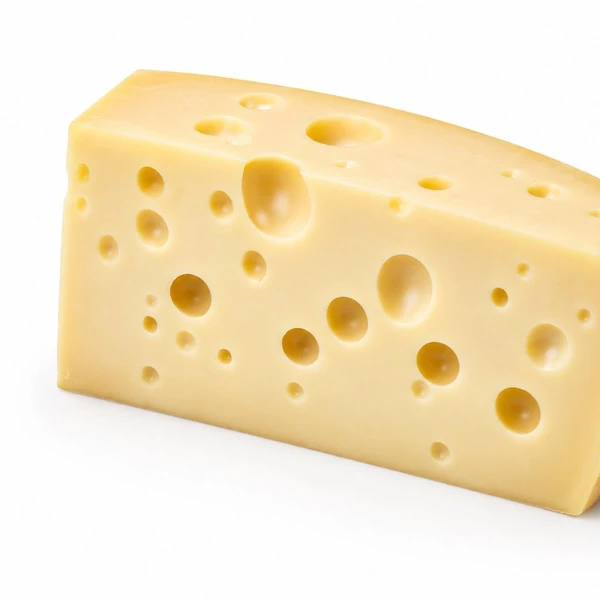
The one the holes made famous:
Stretched cheese — pasta filata
The curd is dipped in hot water and pulled and folded like taffy. The Italian name simply means spun paste. That working gives the cheese a grain, which is why it tears in strands and why it stretches into ropes on a pizza. Burrata takes the idea one step further: a pouch made from the stretched curd, filled with cream and shredded offcuts. It began as a thrifty way to use up scraps and now sells for considerably more than the cheese it was made from.
Pull these apart and they come away in strands:
Whey cheese — made from what used to be thrown away
Making cheese leaves behind a great deal of yellowish liquid called whey, and there is still protein in it. Heat it again and you can lift out soft curds — that is ricotta, whose name literally means recooked. Strictly speaking it is not made by setting milk at all but from what was left over, which is why some definitions decline to call it cheese. It tastes clean and faintly sweet, works in cooking, and becomes dessert with nothing more than honey poured over it.
One cheese came out of this method:
Cheeses kept in brine
Before refrigeration, hot countries stored cheese submerged in salt water, and that method survives intact in this family. They are frankly salty, they stay moist because they are never dry, and they develop little aged aroma. Keep the brine when you get it home and return the cheese to it — it lasts far longer that way. If the salt is too much, soak the piece in cold water for twenty or thirty minutes before eating. One member of the family has the further trick of refusing to melt at all.
Sold sitting in their own brine:
Where does processed cheese fit?
There is one more group that belongs to none of the above: cheese that has been melted with emulsifying salts and set again. Wrapped slices and foil triangles are the familiar examples. It was invented in the early twentieth century to make cheese that could travel and keep, and it achieved that goal completely — uniform, reliably melting, long-lived. What it does not have is the complexity that comes from ageing. The two are not rivals so much as different tools. What you drop onto instant noodles need not be what you serve with wine.